Why welding is the part to check
A frame is only as strong as its connections, and most of them are welded in the factory. Once a weld is painted, you can't see its quality. Once the steel is on site, a bad weld is expensive to find and fix. The documents below are how a factory proves its welding was controlled while it happened.
Then agree the weld quality level with your engineer before you order, not after the steel arrives.
For projects in the EU: the EN 1090-1 certificate
In the EU, structural steel components need CE marking under the Construction Products Regulation, and the standard behind it is EN 1090-1. Before a fabricator can CE-mark its components, a notified body has to audit and certify its factory production control. That certificate is the first document to ask for.
Check four things on it:
- The notified body number: four digits, next to the issuer's name. You can look it up in the European Commission's NANDO database. A CE document with no notified body number can't support CE marking of structural steel.
- The execution class: EN 1090-2 sets four, EXC1 to EXC4. Your engineer sets the class for your structure, and most buildings are EXC2. The certificate has to cover at least that class.
- The scope: welded structural components, and material groups (EN ISO 15608) that match your steel grade.
- The holder and the date: the factory that welds your steel, and a certificate that is still valid.
Then ask how the CE marking and the Declaration of Performance will be issued for your order. Outside the EU, nobody requires EN 1090. It still answers the question this whole list is about: was the welding controlled?
1. The welding quality system: ISO 3834
- ISO 3834 sets quality requirements for fusion welding. Part 2 is the comprehensive level, Part 3 the standard level and Part 4 the elementary level.
- EN 1090-2 links the two: EXC2 work needs at least ISO 3834-3, and EXC3 and EXC4 need ISO 3834-2.
- Check the part number, the issuer, the holder's name and the expiry date. The holder should be the factory that welds your steel, not a sister company or a trader.
- The certificate shows the system passed an audit. It doesn't replace the procedure and welder records below; it's the reason they should exist.
2. Qualified welding procedures: WPS and WPQR
- A WPS (welding procedure specification) is the recipe: process, filler, preheat, joint design, positions. A WPQR (welding procedure qualification record, to ISO 15614-1) is the test record that proves the recipe works.
- Every WPQR has a range of qualification: material group, thickness range, process, position and more. A procedure qualified on 10 mm plate won't cover 40 mm flanges.
- Ask for the WPQRs that cover your main joints, and have your engineer check the ranges.
3. Qualified welders: ISO 9606-1
- Procedures don't weld; people do. ISO 9606-1 qualifies a welder for a process, a material group, a thickness range and positions.
- Check the names, the ranges and the dates. The certificate must be confirmed every six months by the employer's welding coordinator or the examiner. It's revalidated every two or three years, or kept valid with documented production welds. Look for those signatures.
- Ask for the certificates of the welders who will work on your order.
4. A named welding coordinator
- ISO 3834-2 and -3 require welding coordination: people responsible for the welding, qualified to ISO 14731. A common qualification is IWE (International Welding Engineer).
- Ask for the name. A factory that can tell you who signs off its welding has someone who does.
5. Inspection records and the acceptance level
- Agree the quality level before you order. ISO 5817 sets three levels for weld imperfections: B (stringent), C (intermediate) and D (moderate). Your engineer or your project specification should set it, not the factory.
- Agree how much testing: which welds get ultrasonic testing (UT), and what share of them.
- Ask what will come with your steel: UT reports, visual and dimensional records, coating thickness records. Ask which inspections you or your inspector can attend.
Red flags
- A CE or EN 1090 document with no four-digit notified body number, or an execution class below what your structure needs.
- The certificate holder isn't the factory that will weld your steel.
- A certificate past its expiry date, or a WPQR whose range doesn't cover your steel grade or thickness.
- “Our welders are certified”, with no names and no certificates.
- No inspection records offered, or no hold point your inspector can attend.
Where Zhongwei Steel Structure stands
Our welding documents, with numbers you can check:
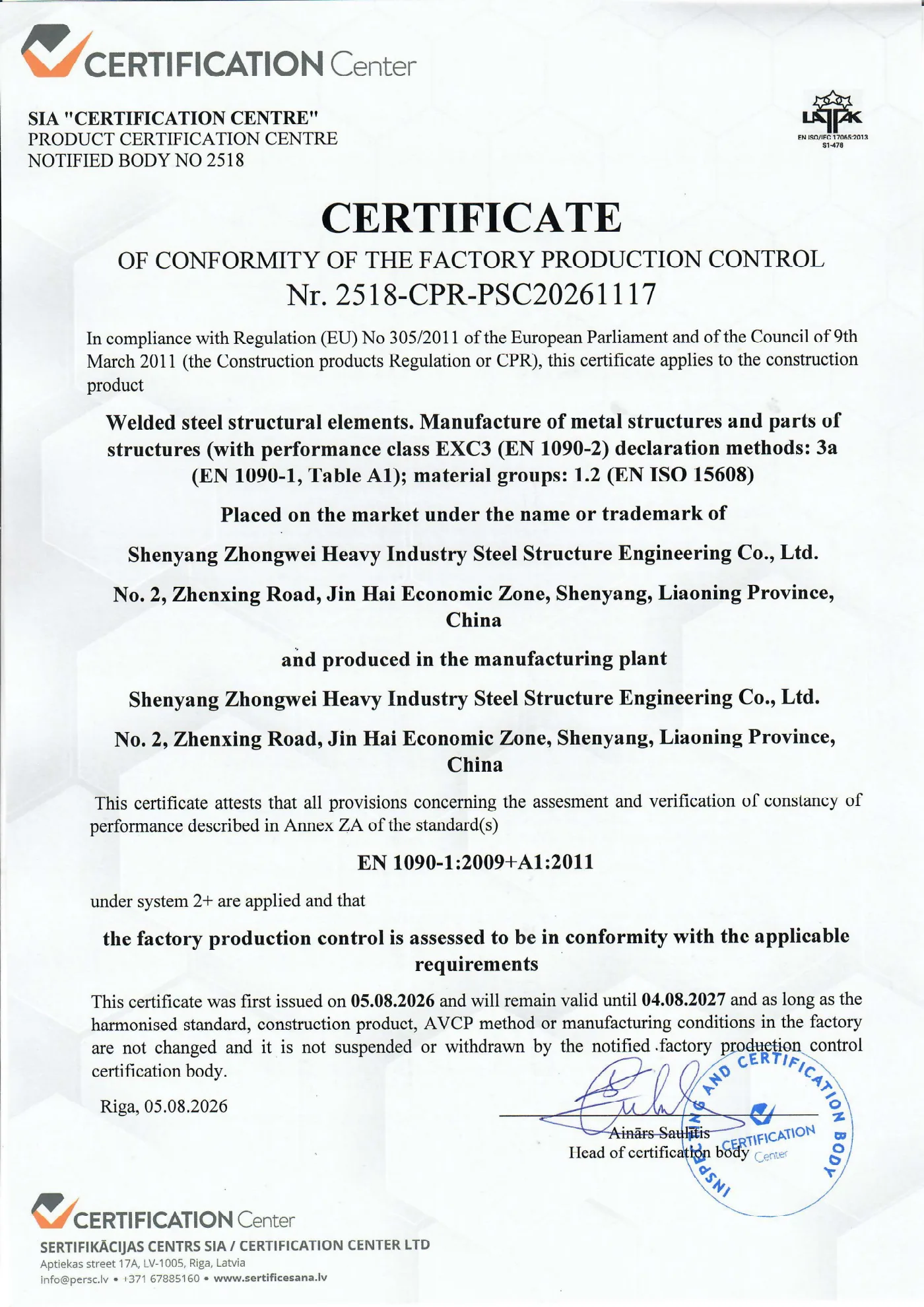
- EN 1090-1 factory production control: certificate No. 2518-CPR-PSC20261117 from Notified Body 2518, Certification Centre Ltd, Riga, Latvia. It covers welded steel structural elements up to execution class EXC3 (EN 1090-2), material group 1.2 (EN ISO 15608), and is valid to 4 August 2027.
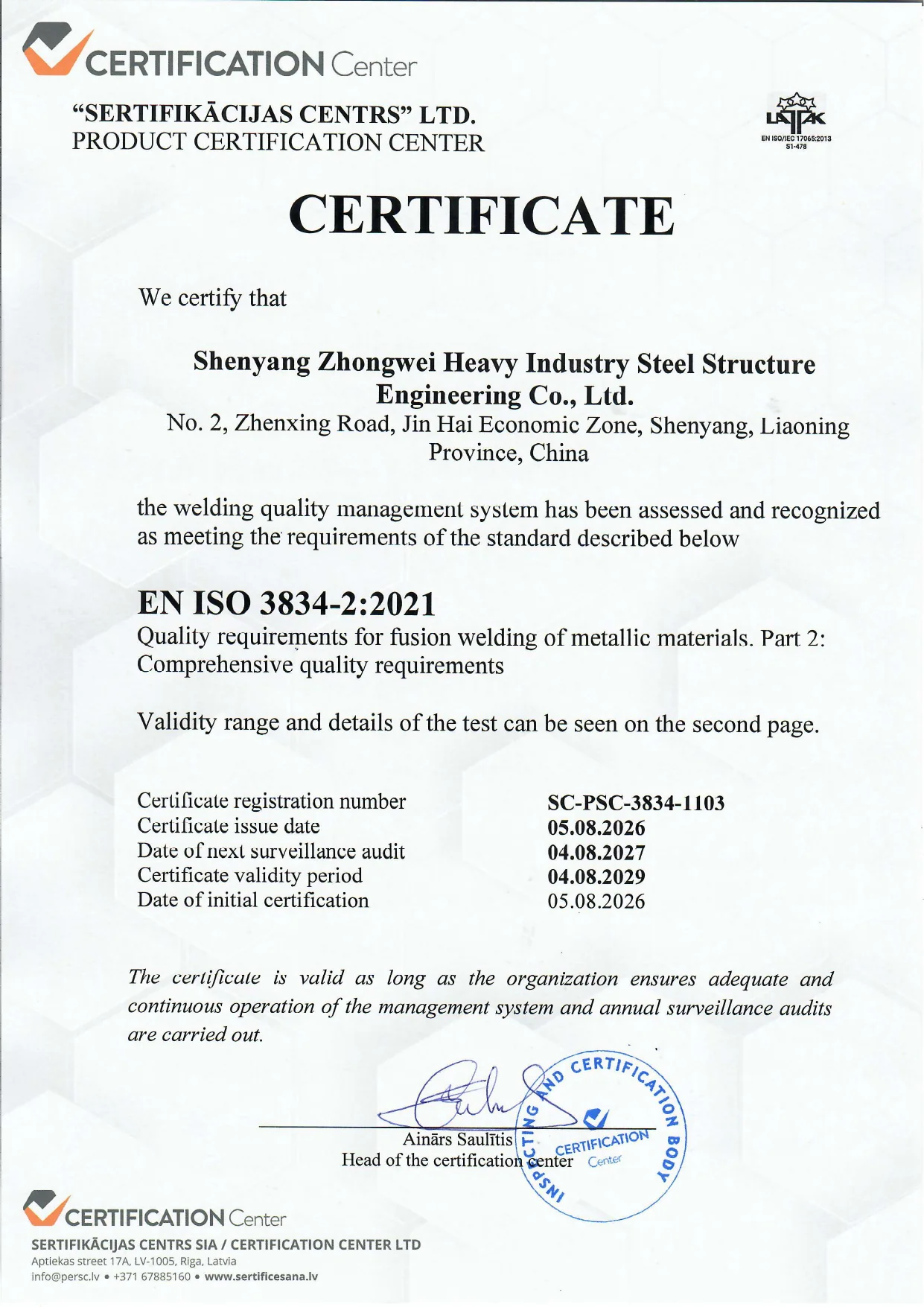
- EN ISO 3834-2, the comprehensive level: No. SC-PSC-3834-1103, from the same body, valid to 4 August 2029.
- Welding procedures qualified to EN ISO 15614-1: WPQR 9602 and 9603, issued 3 August 2026.
- Welders qualified to EN ISO 9606-1. A sample certificate, No. SC-SSC-M-2025/9563, is valid to 15 April 2029. We send the certificates of the welders on your order on request.
- Welding coordinator: IWE qualified. UT operators: Level III. Instruments calibrated every 12 months.
- An inspection and test plan (ITP) with four hold points and three witness points, open to your inspector.
- Acceptance to GB 50205, EN 1090-2 and EN ISO 5817, or to your project specification.
All our certificates, with issuers and numbers, are on the company facts page.
One question to take to any supplier
“Can you send the WPQR that covers my steel grade and thickness, and the certificates of the welders who will weld my order?” A factory that controls its welding can answer within a day.
For an EU project, add one more: “Which notified body certifies your EN 1090-1 factory production control, and up to which execution class?”